
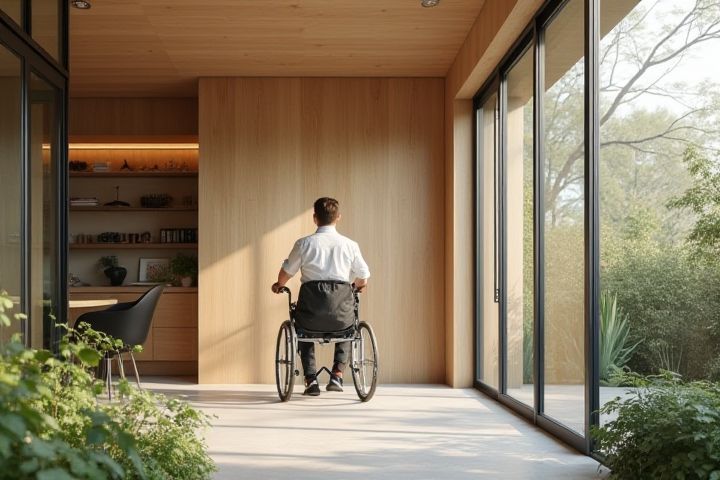
When designing a house for accessibility, prioritize features that accommodate individuals with varying mobility needs. Incorporate wide doorways and hallways, ensuring a minimum width of 36 inches to facilitate wheelchair access. Utilize lever-style door handles and touchless faucets to enhance usability for those with limited hand strength. Consider installing a zero-step entry and ramps instead of stairs, allowing smooth transitions between different levels of the home. Additionally, including adjustable countertops and accessible bathrooms equipped with grab bars can greatly improve safety and comfort for all residents.
How To Design A House For Accessibility
Wide doorways and hallways
When designing a house for accessibility, prioritize wide doorways that are at least 36 inches wide to accommodate wheelchairs and mobility devices, creating easier navigation throughout the home. Hallways should also be spacious, ideally 42 inches or more, allowing for smooth movement and safe passage for individuals with mobility challenges. Consider the use of lever-style door handles, which are more accessible than traditional round knobs, enhancing usability for those with limited hand strength. Installing lower thresholds can further improve access, ensuring a seamless transition between different areas of your home.
Step-free entry
When designing a house with a focus on accessibility, incorporating step-free entry is crucial. Ensure that the main entrance features a gentle ramp with a gradient of 1:12, adhering to ADA guidelines to allow smooth wheelchair access. Install a threshold that is no higher than 1/2 inch to eliminate tripping hazards, promoting ease of access for everyone, including those with mobility challenges. Consider outfitting doorways with a minimum width of 32 inches and lever-style handles for easier navigation in and out of your home.
Lever-style door handles
Lever-style door handles are an essential feature in accessible house design, allowing individuals with limited hand strength or mobility to operate doors effortlessly. Installing these handles at a height between 34 to 48 inches ensures easy reach for individuals in wheelchairs as well as those standing. Exiting or entering through doors equipped with lever handles requires less force--typically around 5 to 7 pounds of pressure--compared to traditional knobs, enhancing usability for all. When selecting finishes, opt for non-slip materials to provide added grip and encourage independence for you and your guests.
Accessible kitchen counters
When designing accessible kitchen counters, it's essential to ensure that the countertop height ranges from 28 to 36 inches, accommodating both seated and standing users. Incorporate knee space of at least 27 inches underneath the counter to allow wheelchair users easy access. Install contrasting color schemes to help visually impaired individuals distinguish between different areas of the kitchen. For increased functionality, consider pull-out shelves or drawers that can be accessed from a seated position, enhancing usability for everyone.
Non-slip flooring
Non-slip flooring is essential for creating a safe and accessible home environment, especially for individuals with mobility challenges. When selecting flooring materials, consider options such as textured vinyl, rubber, or treated hardwood that provide both durability and traction. Aim for a slope of 1:12 for ramps and maintain a consistent surface level to reduce trip hazards. Remember to keep area rugs to a minimum, as they can pose additional obstacles and increase the risk of slips and falls.
Barrier-free shower
A barrier-free shower should have a minimum area of 5 feet by 5 feet to allow for wheelchair access, ensuring the design accommodates users with mobility challenges. Incorporate a zero-threshold entry, where the floor of the shower aligns seamlessly with the surrounding bathroom floor, preventing any tripping hazards. Install grab bars along the walls at a height of 33 to 36 inches, providing support for individuals getting in and out of the shower safely. Non-slip tiles with a coefficient of friction of 0.6 or higher are essential for minimizing the risk of falls, enhancing overall safety in your accessible bathing space.
Grab bars in bathrooms
Incorporating grab bars in bathrooms enhances safety and accessibility, crucial for individuals with mobility challenges. Install grab bars at a height of 33 to 36 inches from the floor, ensuring they can support at least 250 pounds of weight. Position them near toilets and in the shower or bathtub to provide secure support during transfer and balance. Choose grab bars with a textured surface, which can improve grip and prevent slips, making your bathroom safer for everyone.
Lower positioned light switches
Lower positioned light switches ensure accessibility for individuals with mobility challenges, enhancing overall usability in your home. Install light switches at a height of 15 to 48 inches above the floor, allowing wheelchair users to reach them comfortably. Use paddle-style switches, which are easier to operate without fine motor skills, and consider installing dimmer switches that are also within this height range for enhanced lighting control. Implement contrasting colors to improve visibility against the wall, ensuring that everyone can easily locate and operate the switches.
Ample lighting
Designing a house for accessibility with a focus on ample lighting requires careful planning. Use large windows and skylights to harness natural light, which can boost mood and reduce energy costs by 10-30%. Incorporate LED fixtures with adjustable brightness, ensuring that areas like hallways and staircases have a minimum of 100 lux for safe navigation. You can enhance visibility with contrasting colors on walls and floors, aiding individuals with visual impairments, while motion-sensor lights provide convenience for those with mobility challenges.
Open floor plan
An open floor plan enhances accessibility by creating a spacious environment that minimizes obstacles, making navigation easier for individuals with mobility challenges. Ensure doorways are at least 36 inches wide to accommodate wheelchairs and install flooring that is slip-resistant and easy to traverse. Incorporate adjustable kitchen counters and cabinets within reachable heights, allowing you to cook and store items comfortably. Strategically place furniture to promote clear pathways, ensuring maneuverability while maintaining a welcoming atmosphere for everyone.